
Three days after moving into their first house in Naperville, Illinois, my neighbors found their back door standing open. Nothing was taken — whoever it was got spooked, maybe by the dog they didn’t know was there — but the frame was cracked clean from the jamb, the deadbolt had popped right through it, and the whole thing had taken maybe four seconds. The lock itself was fine. It was the door frame that had never stood a chance.
That’s the part that most home security advice doesn’t actually tell you. You can spend $300 on a smart lock and still have a door that a determined person can kick open in one hit, because the lock is only as strong as what it’s bolted into. The conversation around how to secure home entry points usually starts and ends at the lock hardware — and it misses the much larger picture entirely.
If you just bought a house, or you’re looking at your doors and windows for the first time and suddenly feeling like they might not be as solid as you assumed, you are not being paranoid. According to the FBI’s 2023 Crime Data Explorer report, roughly 60% of all burglaries in the United States involve some form of forced entry — and the majority of those forced entries happen at doors, not windows. The average time it takes for a burglar to gain entry? Under 90 seconds at a typical residential door. What’s worse: most of those doors had locks on them.
This guide is going to walk you through every entry point in your home, starting with the ones most guides ignore, and give you specific, affordable, and genuinely effective ways to make each one much harder to get through. No alarm subscription required.
What are the weakest home entry points and why do they matter?
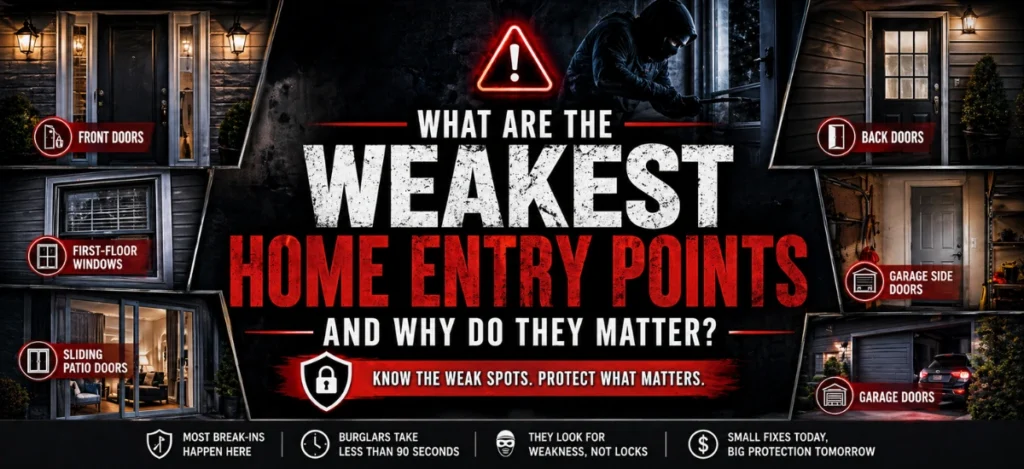
The weakest entry point in most American homes isn’t the front door. It’s the door between the garage and the house. That door is almost always hollow-core, often has a simple spring latch instead of a deadbolt, and because it feels “interior,” homeowners treat it like an interior door. But once someone is inside your garage — which can happen in seconds with an exposed keypad code or a stolen remote — that door is the only thing between them and your living space.
Home security weak points fall into a few consistent categories: hardware that’s technically present but structurally inadequate, secondary entry points that go overlooked because they feel less exposed, and entry points that were upgraded cosmetically but not mechanically. A fresh coat of paint on a door doesn’t change the fact that the strike plate holding the deadbolt is attached with ¾-inch screws into soft pine.
The three categories of entry point vulnerability
Understanding why an entry point is vulnerable helps you fix the right thing. There are three root causes behind almost every residential forced entry:
- Frame and jamb failure: The lock holds, but the wood around it doesn’t. This is the most common cause of door kick-ins and the easiest to fix for under $30.
- Hardware that only looks secure: A single-cylinder deadbolt with a short bolt throw, a window lock that’s essentially a plastic tab, or a sliding door with only a factory latch.
- Entry points that receive zero security attention: Garage side doors, basement windows, pet doors large enough for a child to reach through to a nearby handle, and unlocked access hatches.
According to a 2022 study by the University of North Carolina at Charlotte’s Department of Criminal Justice, 83% of convicted burglars said they specifically checked for ease of entry before attempting a break-in. They were not targeting locks. They were targeting weakness — and the easiest weakness to find is the one the homeowner forgot to think about.
“83% of convicted burglars said they specifically checked for ease of entry before attempting a break-in. They weren’t targeting locks. They were targeting weakness.”
Common Home Entry Points: Vulnerability Level and Fix Cost
| Entry Point | Vulnerability Level | Most Common Weakness | DIY Fix Cost (Approx.) | Time to Fix |
| Front door | Medium | Weak strike plate, short screws | $15–$40 | 20–30 min |
| Back door | High | No deadbolt, hollow core | $80–$150 | 1–2 hrs |
| Garage-to-house door | Very High | Hollow core, spring latch only | $100–$250 | 2–4 hrs |
| Sliding glass/patio door | High | Factory latch, liftable track | $20–$60 | 30–60 min |
| First-floor windows | Medium–High | Cheap factory locks, single latch | $10–$30 per window | 10–15 min each |
| Garage door (main) | Medium | Code sharing, remote cloning | $30–$80 | 30–45 min |
| Basement windows | High | Often forgotten entirely | $10–$25 per window | 10–15 min each |
Source: Approximate costs based on national retail averages (2024–2025). Vulnerability ratings derived from FBI UCR forced entry data and security industry assessments.
How do you do a front door security upgrade the right way?
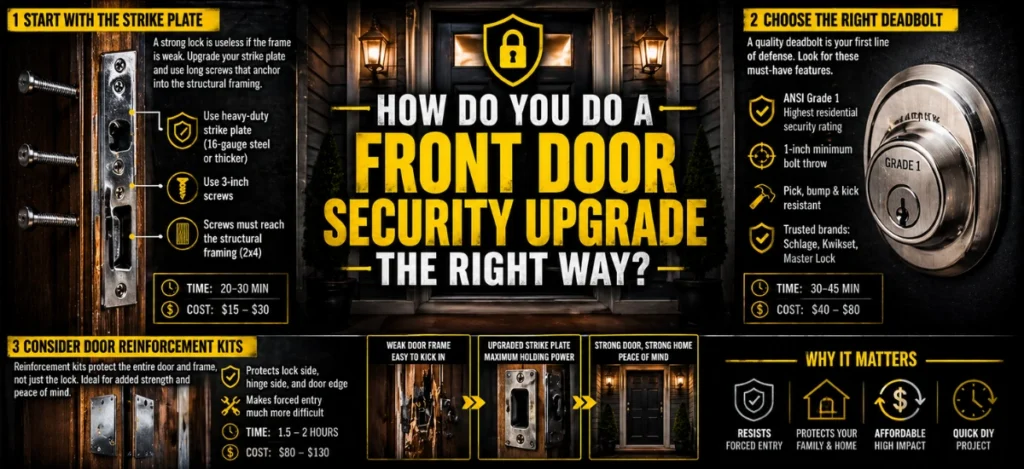
The front door security upgrade most people make is buying a better lock. That’s not wrong — but it’s the second thing you should do, not the first. The first thing is fixing the frame it bolts into, because a $200 deadbolt installed into a weak strike plate with ¾-inch screws into hollow jamb wood will still fail in one kick.
Start with the strike plate — not the lock
A standard residential strike plate comes with two screws, usually about ¾ inch to 1 inch long. Those screws go into the door jamb, which is a thin piece of wood attached to the actual structural framing of your house. A determined kick transfers force directly to those screws. If they’re short and in soft wood, the plate pulls free immediately.
Replace your strike plate with a heavy-duty version — look for ones made from 16-gauge steel or heavier, with at least four screw holes — and use 3-inch screws. Three-inch screws reach through the jamb and into the structural 2×4 framing behind it. That’s the difference between a door that fails in one kick and one that absorbs multiple blows without giving. A quality strike plate with proper screws costs between $15 and $30. It’s the single highest-value security improvement you can make to any exterior door.
Deadbolt installation guide: what to look for
Once the frame is solid, your deadbolt matters. Look for a Grade 1 ANSI-rated deadbolt — this is the highest residential rating, and it means the lock has been tested to withstand at least 250 pounds of direct force and 10 one-minute pick attempts. The bolt itself should have a minimum 1-inch throw (the distance it extends into the frame). Most cheap deadbolts have a ½-inch throw, which gives far less structural resistance.
Brands like Schlage, Kwikset (specifically their SmartKey or Deadbolt series), and Master Lock’s commercial-grade options all make solid ANSI Grade 1 deadbolts available at most hardware stores for $40 to $80. You don’t need to spend more than that for a well-protected door — you need the right specifications, not the highest price tag.
Door reinforcement kits: are they worth it?
The best door reinforcement kit does something a single strike plate can’t: it protects the entire door jamb length, not just the bolt point. Products like the Door Armor MAX or the Armor Concepts EZ Armor wrap steel around the hinge side, the strike side, and the door edge simultaneously. These kits typically run between $80 and $130 and take about two hours to install. If you’re in a neighborhood with higher risk, or if your door is an older hollow-core style, a full reinforcement kit is genuinely worth it.
How do you secure a back door that’s out of sight?
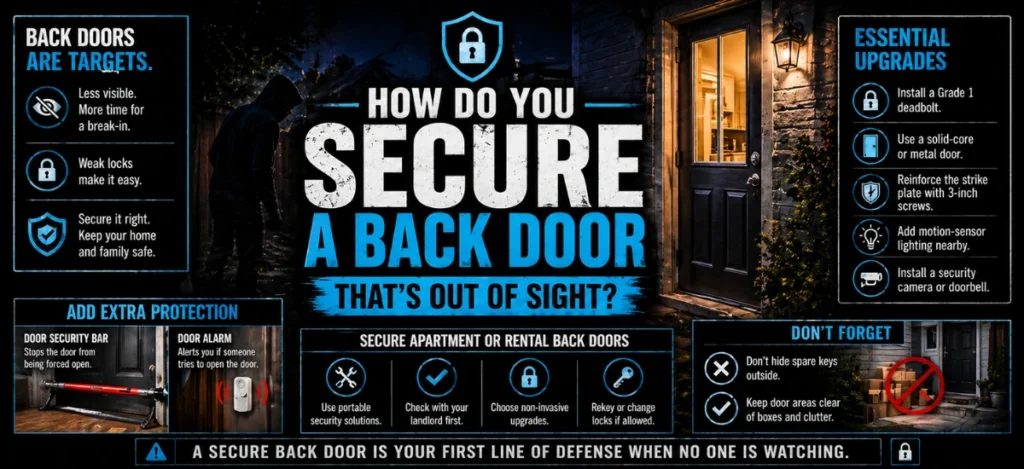
Back doors get broken into more often than front doors, and the reason is simple: they’re less visible. A front door sits on a street-facing face of a home with neighbors, passersby, and traffic to create natural surveillance. A back door is usually tucked behind a fence, a deck, or a tree line — and a burglar has time to work on it without anyone seeing.
The most common back door in American suburban homes is a hollow-core door with a single keyed knob lock and no deadbolt. That door can be compromised in seconds, and not even by force — a credit card or a thin shim can open a spring latch in moments. If your back door doesn’t have a quality deadbolt, that’s the first fix.
The door security bar: underused and highly effective
A door security bar, sometimes called a door barricade bar, braces the door from the inside by wedging between the handle and the floor. Even if someone bypasses the lock completely, they can’t push the door open against a properly seated security bar. The Master Lock Security Bar, for example, adjusts for most standard door heights, costs about $35, and requires no installation at all — you just use it at night or when you’re home.
This is especially useful in apartments, where you often can’t modify the door hardware because you rent. A door security bar gives you meaningful added protection on any inward-swinging door without touching the landlord’s deadbolt.
Worth saving: The door security bar trick also works on hotel rooms, vacation rentals, and any unfamiliar space where you’re sleeping and can’t verify the lock quality. Throw a $35 security bar in your bag when you travel.
Secure apartment entry doors: special considerations
Renters face a unique challenge: you can’t always drill holes, replace locks, or reinforce the frame without landlord permission. Beyond the security bar, look into door frame reinforcement plates that use existing screw holes (just replace the short screws with long ones — most landlords won’t even notice). Door hinge bolts that prevent hinge-side attacks also require only a small modification that’s easily reversible. And if your front door has a peephole, replace the lens with a wide-angle version — original peepholes often have only a 90° field of view, while wide-angle lenses give you 200°.
What window security locks and films actually work?
Window break-ins account for roughly 23% of residential forced entries, according to FBI data. Most first-floor windows in American homes built before 2010 have single-layer locks that function more as position holders than actual security hardware. A double-hung window with a factory latch can often be opened by someone who shakes the frame firmly enough to disengage the latch — no tools needed.
Window security locks: the simple ones that work
The most effective low-cost window security upgrade is a sash pin. You drill a downward-angled hole through the inside sash and partway into the outside sash, then insert a removable steel pin. The window simply cannot open while the pin is in place, regardless of lock condition. This costs about $5 per window in hardware and takes ten minutes to install. For windows you want to be able to open for ventilation, a ventilation stop allows you to lock the window open a few inches but no further — enough for a breeze, not enough for a person.
Window track stops (small plastic or metal blockers that sit in the track) work on sliding windows and are similarly cheap and fast to install. They’re not meant to stop a determined person, but they add enough friction to turn a silent, easy entry into a noisy, difficult one — and that alone is often enough to make a burglar move on.
Security film for windows: what it does and doesn’t do
Security window film is one of the most misunderstood products in home security. Here’s the thing people don’t tell you: security film doesn’t prevent windows from breaking. What it does is hold the shattered glass together, turning a clean punch-through into a slow, difficult, noisy process. A burglar who breaks a window expecting to reach through and unlock it in three seconds now has a sheet of intact but cracked film blocking the way, and making that film yield takes visible effort and audible noise.
Film thickness matters significantly. Decorative film starts at about 2 mil. Security-grade film starts at 4 mil and goes up to 14 mil for blast-resistant applications. For home use, 4 to 8 mil security film is the practical range — you can find 50-foot rolls at home improvement stores for $30 to $80, and installation is a DIY project. Apply it to the inside surface of first-floor windows and any window adjacent to a door handle or lock.
The surprising part: A 2019 study by the CPSC found that laminated and filmed windows reduced the likelihood of break-in completion by nearly 50% compared to bare glass — not because they stop entry, but because they make the process slow and loud enough to deter continuation. Noise is security.
How do you secure a sliding glass door against forced entry?
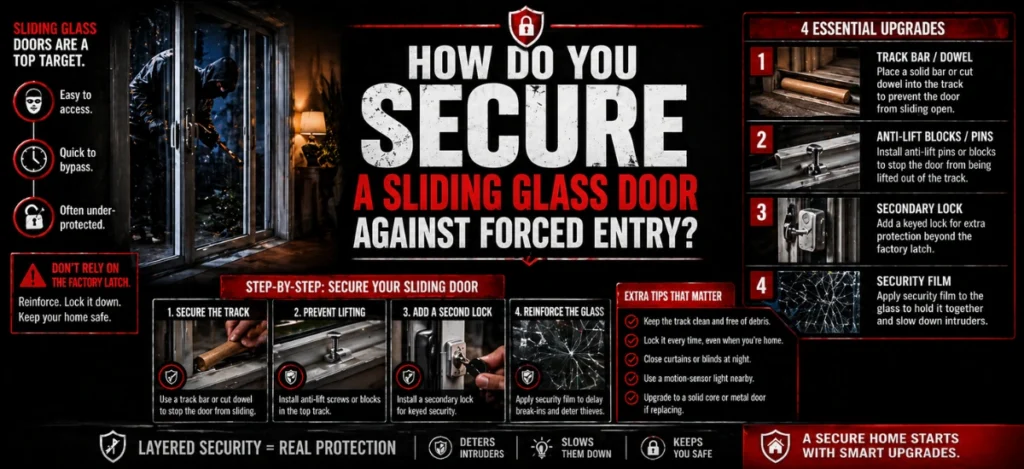
Sliding glass doors are among the most common home entry points, and they’re often among the least protected. The factory latch that comes on most sliding doors is essentially a hook that catches a small ledge — apply upward pressure to a slightly loose door panel, and that latch can disengage. Many older sliding doors can also be lifted physically off their tracks from outside if the track clearance allows it.
The patio door security bar: the essential first step
A patio door security bar — essentially a cut-to-length wooden dowel or a purpose-made metal bar that sits in the track behind the sliding panel — prevents the door from being opened even if the latch is defeated. You can use a wooden broomstick cut to length (free if you have one) or buy an adjustable version with a rubber grip for about $20. This is the minimum for any sliding door, and it should be used any time you’re home or away.
Anti-lift pins and track security
To prevent the door from being lifted off the track, install anti-lift pins. These are screws inserted through the top track of the door frame at an angle, positioned so the door panel can’t be lifted more than a fraction of an inch. Most sliding doors take two anti-lift pins — one toward each end of the panel. The screws cost under $5 and take about 15 minutes to install. Combined with a track bar, this setup makes a sliding door meaningfully more resistant to forced entry than its original factory state.
For additional peace of mind, a secondary lock — either a loop lock that clamps around the frame or a sliding door deadbolt that mounts to the door panel itself — adds a keyed mechanism that goes beyond the factory latch. Brands like Ideal Security and Master Lock make versions that install without professional help and run between $20 and $50.
What garage door security tips do most homeowners skip?
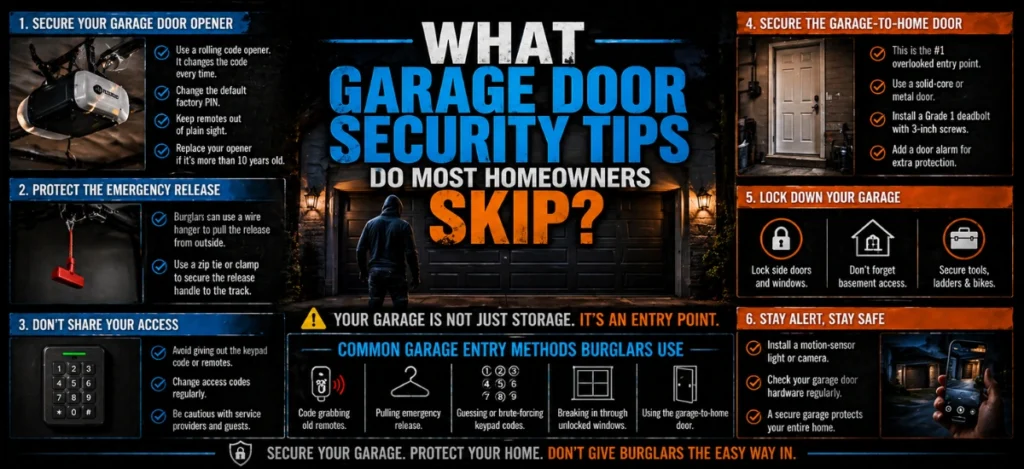
Garage door security has two completely separate components that most guides collapse into one, which is why people end up addressing only half the problem. There’s the main garage door — the large rolling panel — and then there’s the door from the garage into the house. They require different approaches, and neglecting either one creates a real vulnerability.
Securing the main garage door
The main garage door opener remote is a target. Original-issue remotes from older openers use fixed codes, which can be captured and replicated with inexpensive electronic tools — a technique called code grabbing. If your opener is more than ten years old and doesn’t have rolling code technology (most modern openers do), it’s worth upgrading the opener or at minimum the receiver. Rolling code technology generates a new code every time the remote is used, rendering any captured signal useless.
If you have a manual garage door as a backup, always use the interior lock when you’re away for an extended time. And disable the emergency release cord access from outside — there’s an old trick where a wire hook slipped through the top of the door can pull the emergency release and open the door without any electronics. A zip tie through the release cord’s handle prevents this without affecting legitimate emergency use.
The garage-to-house door: treat it like an exterior door
The door between your garage and your living space should be treated exactly like an exterior door — because functionally, it is one. Replace any hollow-core door with a solid-core or steel door. Install a Grade 1 deadbolt. Reinforce the strike plate with 3-inch screws. Add a door alarm if you want notification when it opens. This single door is the most overlooked security gap in the American suburban home, and it’s the one that makes every other garage door measure incomplete if left unaddressed.
Smart lock vs traditional lock — which one actually keeps you safer?
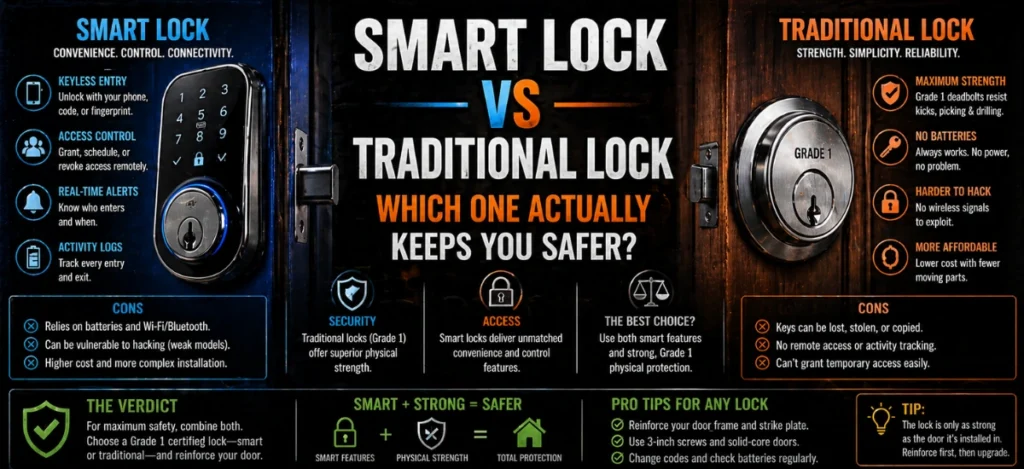
The smart lock vs traditional lock debate is often framed as a technology question when it’s actually a use-case question. A traditional deadbolt with a Grade 1 ANSI rating is physically more resistant to forced entry than most smart locks — smart locks prioritize access control and convenience, and their cases are often made from zinc alloy rather than the hardened steel of commercial-grade mechanical locks.
Where smart locks genuinely add value is in behaviors that mechanical locks can’t address: knowing who came and went and when, being able to grant temporary access without making keys, and getting an alert when your door has been left unlocked for more than an hour. If you have teenagers, service workers, or short-term rentals, that access control capability has real security value.
The honest answer most security guides won’t give you
The best setup isn’t smart lock or traditional lock — it’s both. Use a Grade 1 deadbolt with a reinforced strike plate as your primary physical barrier, and add a smart lock for access management and monitoring. Products like the Schlage Encode and the Yale Assure Lock 2 are smart locks that also carry Grade 1 ANSI ratings — they’re the exception, not the rule, but they exist and they’re worth the $150 to $200 investment if you want both features in one unit.
One caveat for American homeowners specifically: smart lock batteries die. Most use AA or AAA batteries and will notify you when they’re running low, but if you rely on a smart lock as your only entry mechanism and the battery dies while you’re out, you need a backup plan. Keep a physical key hidden securely (not under the doormat — a lockbox with a combination, mounted to a wall bracket, is the right call) or choose a lock with a physical keyway override.
The complete home security checklist for doors and windows
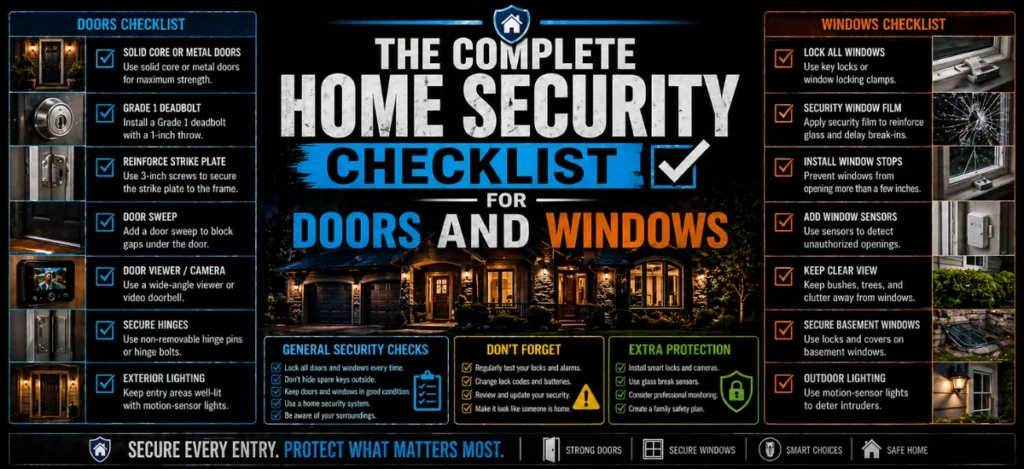
This is the part worth saving. Run through this checklist once a year — and definitely before you travel anywhere for more than a few days. It covers every entry point category in the order you should address them, starting with the highest-impact fixes.
Save this checklist
Print this or bookmark it — this is the complete annual home entry point security audit for any American home. Work through it room by room.
Front and back doors
- Deadbolt present, ANSI Grade 1 rated, 1-inch minimum bolt throw
- Strike plate has 4+ screw holes, minimum 16-gauge steel
- Strike plate screws are at least 3 inches long and seated in structural framing
- Door is solid core (no hollow-core on any exterior door)
- Hinges are on the interior side, or have hinge bolts installed
- Door fits the frame snugly with no visible gap at the latch side
- Wide-angle peephole installed (or video doorbell at eye level)
Windows (first floor and basement)
- Sash pins or ventilation stops installed on all operable windows
- Window track stops on sliding windows
- 4-mil or thicker security film on ground-floor windows (especially near doors)
- Window alarm sensors present, tested within the last 6 months
- No large trees or structures giving easy access to second-floor windows
Sliding glass/patio doors
- Track bar or cut dowel in the track at all times when not in active use
- Anti-lift screws installed in top track
- Secondary keyed lock installed in addition to factory latch
- Security film on all glass panels
Garage
- Opener uses rolling code technology (check model if over 10 years old)
- Emergency release cord protected from outside wire hook access
- Garage-to-house door is solid core with a Grade 1 deadbolt
- Keypad code changed in the last 12 months
- Remote not stored in a visible location inside the vehicle
Key Takeaways
- The door frame, not the lock, is what fails in most residential forced entries — replacing your strike plate with a heavy-duty version and 3-inch screws is the single most effective security upgrade you can make.
- The garage-to-house interior door is the most overlooked high-risk entry point in the American home, and it should be treated with the same hardware as any exterior door.
- Sliding glass doors require at minimum a track bar and anti-lift screws — the factory latch alone is not a meaningful security measure.
- Security window film doesn’t prevent glass from breaking, but it slows down and audibly advertises entry attempts, which is what deters most opportunistic burglars.
- Smart locks add access control and monitoring value but don’t replace the need for a physically strong mechanical deadbolt — the best approach combines both.
- A complete home entry point security audit takes one afternoon, costs under $200 for most homes, and can be done entirely without professional help using basic tools.
- Conducting a yearly security walkthrough — especially before extended travel — is the single most underused habit in residential home security.
Read More: Bathroom Remodel Ideas on a Budget That’ll Make You Forget What It Used to Look Like
Faqs About how to secure home entry points
Replacing a standard strike plate with a heavy-duty version and 3-inch screws takes about 20 to 30 minutes with a screwdriver and a chisel. If you’re installing a full door reinforcement kit like the Door Armor MAX, expect 1.5 to 2 hours for a complete installation. As covered in the front door section above, the frame work should always come before any lock upgrade.
You can meaningfully secure your home for under $100 if you prioritize correctly. Start with 3-inch screws in your strike plates ($5–$15), add window sash pins ($5 per window), drop a track bar behind your sliding door ($0 if you use a cut dowel), and install a door security bar for the back door ($25–$35). That covers the four highest-risk entry points for most American homes at a very low cost.
For pure physical security, any ANSI Grade 1 deadbolt from Schlage or Kwikset’s higher-end lines is the practical gold standard for residential use — they’re tested for pick, bump, and force resistance. If you also want smart features, the Schlage Encode Plus and Yale Assure Lock 2 are both Grade 1 rated with app connectivity. The lock matters less than the frame it’s installed in, so prioritize strike plate reinforcement first.
A cut wooden dowel or adjustable metal bar dropped into the track requires no drilling at all and is just as effective for preventing the door from sliding open. Most sliding door security bars are also tension-mounted rather than drilled. The anti-lift screw method does require drilling, but if that’s not an option, a clamp-on secondary lock for the door panel provides a no-drill alternative.
Not inherently — in fact, many smart locks are physically weaker than a good mechanical deadbolt because their cases prioritize aesthetics over hardened resistance. Smart locks add value through access control, activity logs, and remote monitoring, but they don’t replace physical strength. For American homes, the ideal is a Grade 1-rated smart lock, or a standard Grade 1 deadbolt paired with a separate monitoring device.
Rekey or replace all exterior door locks immediately — you don’t know how many key copies exist from the previous owner or tenants. Then check the strike plates on every exterior door and replace any with screws shorter than 2 inches. Walk the entire perimeter noting every window and door that can be opened from outside. That walk takes 20 minutes and will tell you exactly where to focus your time and budget.
Yes, particularly for first-floor windows adjacent to doors or near easily reached handles. Security film significantly slows glass break-throughs and makes the process audible, which is what deters most opportunistic break-ins. At $30 to $80 for a 50-foot roll that covers multiple windows, it’s one of the higher-value passive security upgrades available for most American suburban homes.
Yes, through a few different methods — code-grabbing older fixed-code remotes, using the emergency release cord via a wire through the door gap, or simply guessing a simple keypad code. As covered in the garage security section, rolling code technology, a zip tie on the emergency release, and a less-obvious keypad code address these vulnerabilities directly. The main door between garage and home is equally important to secure.