
A garden that goes dark the moment the sun sets is a garden working at half its potential. Over the years of designing outdoor spaces and troubleshooting lighting complaints for homeowners, one product category comes up in almost every conversation: solar garden lights. They promise zero electricity bills, no wiring headaches, and a warm glow that turns an ordinary lawn into something worth stepping out for after dark. But not every solar light lives up to that promise, and the difference between a light that lasts three monsoons and one that dies in three months usually comes down to a handful of details most buyers never think to check.
This guide breaks down everything worth knowing before you buy — the types available, what waterproofing actually means, which batteries hold up, and how to keep your lights running at full brightness for years. Whether you are lighting a balcony in Mumbai, a farmhouse driveway in Delhi, or a backyard path anywhere else in the world, the fundamentals below will help you buy once and buy right.
Why Solar Garden Lights Are Worth It in 2026
Solar garden lights are no longer a novelty add-on. They have become a genuine, practical lighting category, and the reasons are straightforward.
- No wiring, no electrician. Since the panel and battery are built into the fixture, installation is usually a matter of pushing a spike into soil or mounting a bracket. There is no conduit work and no risk of an exposed wire near a flower bed.
- Zero running cost. Once charged during the day, these lights draw power from a free, renewable source. Over a year, that adds up to real savings compared to wired landscape lighting.
- Automatic dusk-to-dawn operation. Most modern solar garden lights with sensor technology detect falling light levels and switch on by themselves, then switch off at sunrise. Nobody has to remember to flip a switch every evening.
- Low long-term maintenance. Compared to bulb-and-wire systems that need periodic electrical checks, solar fixtures mostly need occasional cleaning and a battery swap every couple of years.
There is also a mindset shift worth mentioning here. A garden does not need a complete redesign to feel transformed — a small change, like adding a row of solar spike lights along a walkway, changes how the entire space feels after sunset. That is the kind of low-effort, high-reward upgrade worth prioritising before anything more elaborate.
Types of Solar Garden Lights and Where Each One Belongs
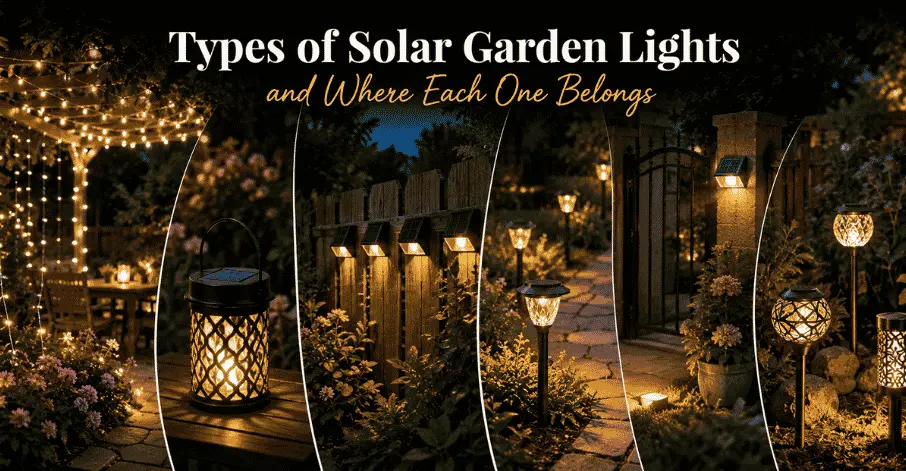
Not every solar light is built for the same job, and this is where most first-time buyers go wrong — they pick a design because it looks good in a product photo rather than asking what it is engineered to do. Matching the fixture type to the space it will live in is the single biggest factor in whether a purchase feels worth it six months later, so the categories below are organised by the job each one does best.
Solar String Lights and Solar Fairy Lights
Solar string lights and solar fairy lights are the go-to choice for patios, pergolas, balcony railings, and outdoor seating areas. They are less about functional visibility and more about atmosphere — the soft, warm points of light that make an evening gathering feel intentional. Solar string lights outdoor models built with UV-resistant copper wire and sealed LED nodes hold up through repeated exposure far better than the thin, decorative versions meant for indoor use. For anyone stringing lights across a larger area such as a fence line or a tree canopy, look specifically for solar string garden lights rated for continuous outdoor exposure rather than seasonal party use.
Solar Lanterns
Solar lanterns bring a more traditional, structured look — ideal for flanking a doorway, lining a pathway, or sitting on a porch step. Unlike string lights, lanterns usually provide steadier, more directional illumination, which makes them useful for both decoration and basic visibility near entrances.
Solar Fence Lights and Gate Lights
Boundary walls and entrances are often the most overlooked lighting zones in a home. Solar fence lights mount directly onto fence posts or wall tops and provide consistent, low-glare illumination along a property line. A well-placed gate-light at the entrance does double duty: it welcomes guests and adds a layer of visibility that supports basic home security, without needing a mains connection anywhere near the gate.
Solar LED Garden and Pathway Spike Lights
For anyone searching specifically for solar led garden lights or led garden lights solar, spike-style pathway lights are usually the answer. These push into soil along a walkway or driveway edge and space evenly to guide movement after dark. Because they sit low to the ground, they are also less prone to wind damage than taller fixtures.
Decorative Solar Garden Lights
This is where personality enters the garden. Solar garden lights decorative designs — sunflowers, fireflies, hydrangea blooms, spinning globes — add a playful, personal layer to outdoor spaces. For homeowners looking for something beyond the standard spike-and-bulb format, unique solar lights for garden in sculptural or colour-changing designs make a noticeable difference in how a space is remembered by guests. Some regions also favour ornamental spiritual or divine lights styles for entrances and courtyards, which blend decorative lighting with cultural or religious significance.
Waterproof Solar Lights for Garden
Here is the detail that separates lights that survive an Indian monsoon from lights that fail after the first heavy downpour: the IP rating.
Think of an IP rating the way you would think of a raincoat versus an umbrella. An umbrella keeps light drizzle off you as long as you hold it just right — that is roughly what a low IP rating like IP44 offers, protection from splashes but not immersion. A proper raincoat, on the other hand, is sealed to keep you dry even in a downpour, no matter which direction the wind is blowing the rain. That level of protection is what an IP65 or IP67 rating provides for a fixture — sealed enough to handle sustained rain, dust, and humidity without water reaching the internal electronics.
Indian outdoor conditions are demanding in ways that most imported or budget fixtures are simply not designed for. Any buyer shortlisting waterproof solar lights for garden india use should account for three stresses specifically:
- Monsoon humidity across states like Maharashtra, Kerala, and the Northeast, where sustained rainfall pushes moisture into any unsealed seam or gap over weeks, not just a single storm.
- Extended summer heat, often crossing 40°C in North Indian cities such as Delhi and Jaipur, which warps cheap plastic housings and degrades adhesive seals well before the next monsoon arrives.
- Dust accumulation, particularly in urban and semi-urban areas, which settles on both the panel and the housing joints and is far heavier here than in most markets these fixtures were originally designed for.
For waterproof solar lights for garden use anywhere in the country, IP65 should be treated as the working minimum, not an aspirational upgrade. Coastal regions and areas prone to waterlogging during peak monsoon — parts of Mumbai, Chennai, and Kolkata among them — are better served by IP67-rated fixtures, since these tolerate brief immersion rather than just direct rain exposure. A fixture rated IP65 or higher, built with UV-stabilised ABS or aluminium housing, is far more likely to survive three or more monsoon cycles without corroding or dimming, where a standard IP44 fixture bought purely on price often needs replacing within a single season. The same logic extends to any solar powered outdoor lights installed in exposed, uncovered locations — porch, driveway, open lawn — versus more sheltered spots like a covered balcony, where a slightly lower rating can still hold up.
Battery and Power: What Actually Keeps These Lights Running
The solar panel gets most of the attention when people shop for these fixtures, but it is the battery sitting quietly inside the housing that actually determines whether a light survives a cloudy week or dies out after two overcast nights. Three battery types dominate the market, and they are not interchangeable in performance.
- NiMH (Nickel-Metal Hydride): The most common and most affordable option in entry-level fixtures. Reliable for basic use but tends to lose capacity faster over repeated charge cycles, especially in extreme heat.
- Li-ion (Lithium-ion): A step up in energy density and charge efficiency, commonly found in mid-range and premium solar light with battery for home setups. Handles heat better than NiMH but still degrades faster than the next option.
- LiFePO4 (Lithium Iron Phosphate): Increasingly used in higher-end fixtures because it tolerates heat well, holds charge longer on cloudy or rainy days, and typically lasts several years longer than standard lithium-ion cells.
When comparing rechargeable batteries for solar garden lights, the number that matters most is capacity, usually listed in mAh. Anything below 600mAh will likely struggle to power a light through a full night during overcast weather. For areas that see extended festival lighting — weddings, Diwali, long outdoor evenings — a 600mAh or higher battery paired with a larger panel surface is worth the extra cost, since standard 200–300mAh units are built for basic ambient lighting rather than extended runtime.
Charge time also deserves attention. A fixture that takes 4 to 6 hours of direct sunlight to reach full charge performs reliably on sunny days but may struggle across several consecutive cloudy or monsoon days. Fixtures with larger panels and higher-capacity batteries close that gap noticeably.
Best Solar Garden Lights for Home Outdoor Spaces, by Use Case
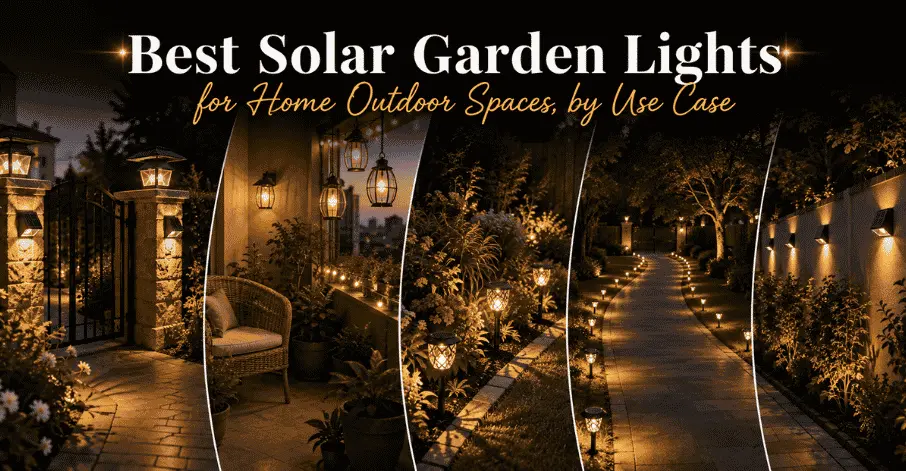
There is no single “best” solar light that works everywhere in a home — the right choice depends on where the light is going and what job it needs to do there. The breakdown below matches common zones around a home to the fixture type best suited for that spot.
- Entrance and gate: A gate-light or solar lantern with a motion or dusk sensor balances welcome-lighting with basic security.
- Balcony or patio: Solar string lights or fairy lights for atmosphere, layered with one or two lanterns for functional light.
- Lawn or garden bed: Decorative solar garden lights — fireflies, flowers, spike lights — spaced to avoid overcrowding a small area.
- Driveway or long pathway: LED garden spike lights placed at consistent intervals, prioritising lumens and IP rating over decorative design.
- Boundary wall or fence line: Solar fence lights mounted at even height for a uniform glow along the property line.
For anyone specifically comparing options and searching for the best solar garden lights available right now, the strongest performers in 2026 share three traits regardless of brand: an IP65-or-higher rating, a battery above 600mAh, and a solar panel positioned or angled for maximum sun exposure rather than a flush, flat design that catches light only at midday.
Buying Checklist Before You Order
Before adding any solar garden light to your cart, run through this list:
- IP rating: IP65 minimum for any exposed outdoor location; IP67 for areas with heavy rain exposure or standing water risk.
- Battery type and capacity: LiFePO4 or Li-ion preferred over basic NiMH; 600mAh or higher for reliable multi-day performance.
- Lumens: Match brightness to purpose — low lumens for ambient decoration, higher lumens for pathway or security use.
- Housing material: Aluminium or UV-stabilised ABS for longevity; avoid thin, untreated plastic for long-term outdoor placement.
- Sensor function: Confirm whether the light includes automatic dusk-to-dawn sensing or motion activation, depending on the intended use.
- Warranty and brand reliability: A visible warranty period is often a reliable signal of build confidence from the manufacturer.
- Panel positioning: Adjustable or angled panels generally outperform flat, fixed panels in real-world charging conditions.
How to Maintain and Clean Solar Panels on Garden Lights
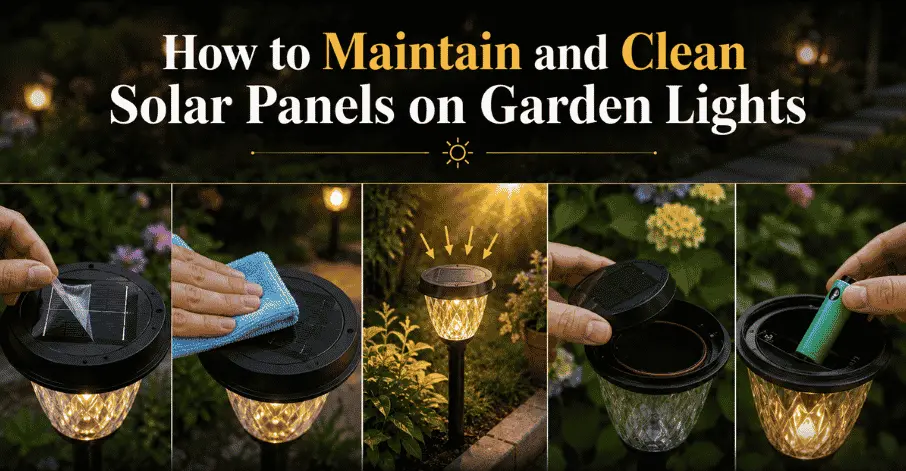
Even the best-built lights will underperform without basic upkeep, and this is the step most homeowners skip entirely — usually because solar lights are marketed as “zero maintenance,” which is only half true. Fixing the most common causes of failure takes only a few minutes per fixture.
- Check for the shipping pull-tab. Brand-new lights sometimes arrive with a plastic tab inside the battery compartment designed to prevent drainage during transit. Leaving it in place is one of the most common reasons a new light “doesn’t work” straight out of the box.
- Wipe the panel every two to three weeks. Dust, pollen, and bird droppings can reduce charging efficiency by half or more, even when the film of grime looks minor. A soft, slightly damp cloth is enough; avoid abrasive materials that can scratch the panel surface.
- Reposition for direct sunlight. A panel shaded by leaves, walls, or nearby furniture for even part of the day will undercharge. Solar garden lights generally need at least six hours of direct sun to perform reliably through the night.
- Inspect seals before monsoon season. Check the rubber gasket around the battery compartment and panel joint for cracks or gaps, since this is where water intrusion typically begins.
- Replace batteries every 18 to 24 months. Even a well-maintained fixture will dim over time simply because rechargeable batteries lose capacity with age. A fresh battery often restores a “dead” light to full brightness.
Skipping these checks is exactly how a two-year-old light ends up in the garbage when a five-minute clean and a battery swap would have solved the problem.
Conclusion
The right solar garden lights do more than illuminate a space — they change how that space is used and experienced after sunset. A well-lit path invites an evening walk. A softly strung patio invites guests to stay a little longer. None of this requires a large investment or a complicated installation; it requires choosing fixtures built for the conditions they will actually face, and giving them the small amount of upkeep they need to keep performing. Start with one zone of the garden, get the fundamentals right — IP rating, battery quality, correct placement — and expand from there. A garden that glows after dark is rarely the result of an expensive overhaul; it is almost always the result of a few well-chosen, well-maintained lights doing their job consistently, night after night.
FAQ‘s about Solar Garden Light
Yes, but performance depends on build quality and battery capacity. IP65-rated lights with a 600mAh+ LiFePO4 or Li-ion battery keep working through cloudy stretches, just with reduced runtime.
The LED components themselves can last for years, but the rechargeable battery is usually the limiting factor. Expect 18 to 24 months of reliable battery performance before a replacement is needed, with the fixture itself lasting considerably longer if properly maintained.
For most households, yes. Sensor-based lights turn on automatically at dusk and off at dawn, which conserves battery life by preventing accidental daytime use .
A soft, slightly damp cloth is sufficient for regular cleaning. Avoid high-pressure water or abrasive scrubbing, which can damage the panel surface or compromise waterproof seals over time.
Solar lanterns provide steadier, more directional light and suit entrances, porches, or pathway edges. Solar fairy lights are designed for ambient, decorative coverage across a wider area, such as a patio or fence line.
The most common cause is a plastic pull-tab left inside the battery compartment to prevent drainage during shipping. Removing this tab resolves the issue in most cases.
IP65 is the practical minimum for any fixture exposed to direct rain. For high-rainfall regions or areas prone to waterlogging, IP67-rated fixtures offer a stronger margin of protection.
Individually, the saving from one light is small, but across a driveway, boundary wall, or full garden layout, eliminating wired landscape lighting adds up to a meaningful reduction in outdoor electricity costs over a year.